
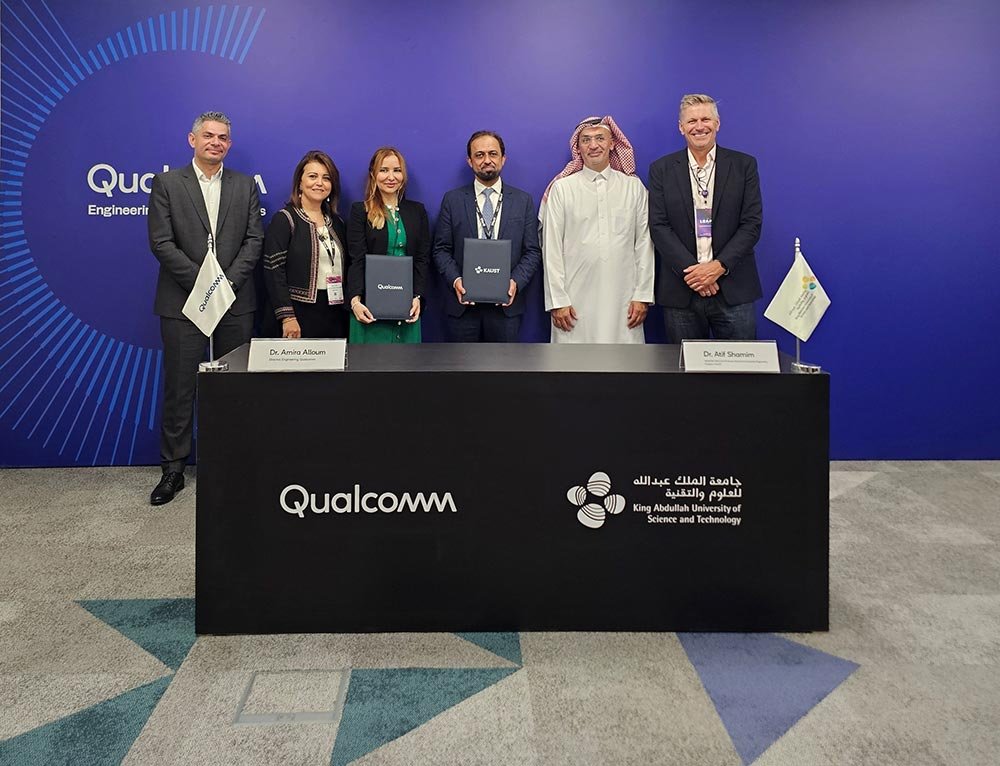
Multifaceted collaboration spans training, applied research, startup pathways and talent development
RIYADH, Saudi Arabia – 1 September, 2026 – Qualcomm Technologies International, Ltd. and King Abdullah University of Science and Technology (KAUST) today announced a strategic collaboration designed to strengthen Saudi Arabia’s leadership in 6G innovation and artificial intelligence (AI). The collaboration brings together education and training, applied research, commercialization support and early-career pathways — reflecting a shared commitment to developing talent and accelerating innovation aligned with the Kingdom’s priorities.
“This collaboration reflects our shared belief that long-term innovation is built by investing in people, research and pathways to real-world application,” said Mohammed Yaqoub, Managing Director, Qualcomm, Saudi Arabia. "By working closely with KAUST, we are supporting the development of advanced capabilities in 6G and Edge AI while helping translate research into scalable solutions aligned with Saudi Arabia’s innovation ambitions.”
“This collaboration with Qualcomm strengthens our ability to connect research, education and innovation,” added Professor Omar Knio, Dean of the Computer, Electrical and Mathematical Sciences and Engineering Division at KAUST. “By bridging the gap between advanced R&D and commercial application, we are creating a powerful engine for talent development and intellectual property creation that serves the long-term goals of Saudi Arabia’s innovation ecosystem.”
The collaboration spans five connected areas:
- Skills and curriculum support in 5G, 6G and AI
- Applied research collaboration in autonomous systems, Edge AI and 6G use cases
- Commercialization and startup pathways, including local innovation programs
- Intellectual property (IP) education to help translate research into impact
- Workforce development through internship pathways
Advancing Skills in 5G, 6G and AI Through Industry-Led Training
Through the collaboration, KAUST students will gain access to industry-led training in 5G wireless technologies and AI via the Qualcomm Academy eLearning platform. Courses are designed and taught by engineers from Qualcomm Technologies and cover topics such as AI fundamentals, generative AI, Edge AI and on-device AI development. They also address the foundational pillars of 5G and wireless communication, which are crucial prerequisites for understanding emerging 6G technologies.
Students will also have access to advanced training pathways through Qualcomm Academy, including 5G wireless certification programs covering cellular communications and network fundamentals, as well as deeper specialization in areas such as 5G architecture, millimeter-wave technologies, massive MIMO and protocol design. Qualcomm Technologies is providing KAUST with complimentary training access and a limited number of certification licenses.
Deepening Applied Research Through the Qualcomm University Relations Platform Program
As part of the Qualcomm University Relations Platform Program, KAUST and Qualcomm Technologies are launching an applied research collaboration spanning 6G wireless research, next-generation autonomous systems, Edge AI and wireless-enabled sensing. This work will support a wider scope of 6G use cases, including Digital Twin, Physical AI, RF sensing, agentic AI and extended reality experiences.
Current and planned activities leverage Qualcomm Dragonwing™ Robotics platforms, the Qualcomm® RB5 Flight Platform and other Qualcomm® AI technologies to explore on-device intelligence across robotics, sensing, XR and industrial applications. Researchers within KAUST’s Electrical and Computer Engineering Department will advance projects ranging from AI-powered underwater exploration and real-time augmented reality (AR) car parking assistance to the Intelligent Structural Health Monitoring project, a flagship initiative applying Edge AI to monitor infrastructure integrity across critical environments, including oil and gas operations.
This research stream reflects a shared focus on on-device intelligence and scalable solutions that can address challenges across infrastructure, oil and gas, and sustainable industrial operations.
Supporting Commercialization Pathways Through Saudi Innovation Programs
The collaboration also supports the journey from research to real-world application by connecting innovation to commercialization pathways. One example is MOBISENSE, a KAUST spinoff, which completed the Design in Saudi Arabia with AI (DISAI-2025) program as part of its first cohort this past December.
During development, MOBISENSE leveraged Qualcomm's AI development ecosystem, including Qualcomm AI Hub and Qualcomm Device Cloud (QDC) for streamlined model discovery, optimization, scalable device selection and deployment.
Recognizing the role of intellectual property (IP) in scaling innovation, the collaboration will also explore opportunities to expand IP literacy and practical know-how. L2Pro Saudi Arabia is a free IP e-learning platform designed to equip startups, SMEs and researchers across the Kingdom with the skills to protect, commercialize and scale their innovations. Hosted at https://L2ProSaudiArabia.com, the platform is being explored with leading Saudi universities, including KAUST, as part of broader efforts to integrate IP education with research commercialization and startup engagement.
As part of workforce development efforts, Qualcomm Technologies will begin hosting internship students from KAUST starting this summer. The initial cohort will include two students from the Electrical and Computer Engineering department, offering hands-on industry experience connected to wireless technology and semiconductor innovation.
Together, these initiatives reflect a shared, long-term approach to building Saudi Arabia’s innovation ecosystem — linking education and research with real-world application and talent development. By combining KAUST’s research excellence with Qualcomm’s industry expertise, the collaboration aims to support the Kingdom’s ambitions to develop advanced capabilities in wireless and AI, while enabling the next generation of innovators to translate ideas into impact.