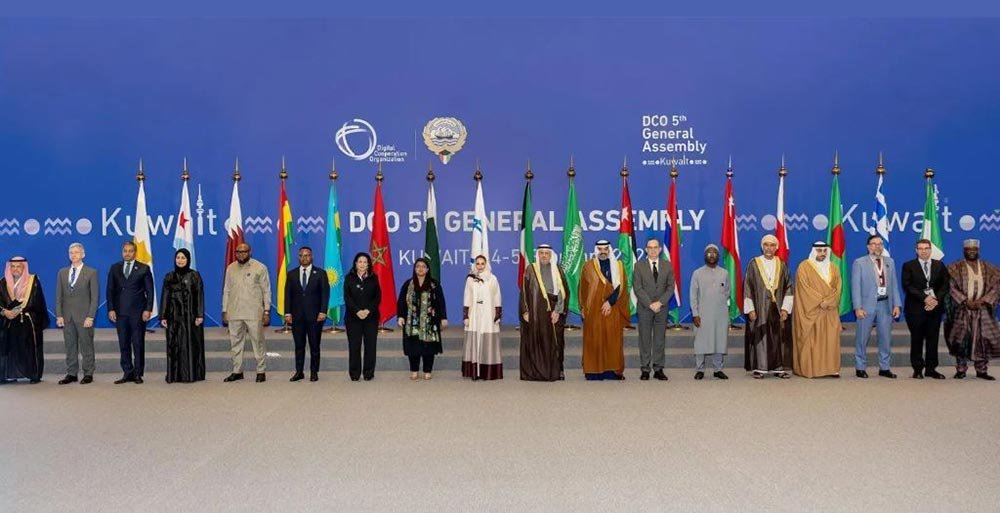
Riyadh, August 29, 2026, SPA -- The Digital Cooperation Organization (DCO), the world’s first standalone international organization dedicated to accelerating the inclusive and sustainable growth of the digital economy, today announced that the DCO Council has approved the candidature of eight new countries to join the organization as member states, which would potentially expand DCO membership from 16 to 24 countries, representing approximately 980 million people.
The DCO confirmed that the Republic of Albania, the Republic of Azerbaijan, the Republic of Kazakhstan, the Republic of Kenya, the Lebanese Republic, the State of Palestine, the Syrian Arab Republic, and the Republic of Zambia will join the organization as member states upon completion of the formal accession procedures, including signing the DCO Charter and its adoption and ratification in accordance with the procedures followed in each country.
In addition, DCO is set to welcome the Republic of Tajikistan as an associate member, opening new opportunities for Tajikistan to strengthen digital cooperation, access public-private partnerships, and collaborate on initiatives advancing digital innovation, skills, and inclusion, in line with its National Development Strategy through 2030.
“When the DCO was launched by five countries in 2020, a standalone organization built around the digital economy outside the traditional blocs, it was an untested proposition. Today, this model has proven successful, with the organization’s membership set to reach 24 countries once the candidate countries complete their accession procedures,” said Secretary-General of the DCO Deemah AlYahya.
“Countries are joining for a practical reason; the rules of the digital economy on data, artificial intelligence, and cross-border trade are being written now, and rules written without you are rules you inherit rather than shape.”
“These prospective accessions are how that changes: not by asking for better terms, but by building the capacity to set them together. That is what digital sovereignty looks like in practice; a membership large enough to negotiate its people’s future.”
“The next stage is scale. Five years of policy, platforms and partnerships could soon have 24 countries behind them, and that is what turns alignment into infrastructure, investment, and rules that hold and shape our collective future,” Al-Yahya concluded.
The growth reflects increasing international confidence in the DCO’s vision and reinforces its role as the leading platform for international digital cooperation. The accessions would expand DCO’s represented population, meaning approximately 12% of the global population would proactively participate in shaping the rules of the digital economy through the organization.
The announcement also marks a significant geographic broadening of the organization’s footprint. For the first time, DCO extends into Central Asia, opening a new regional axis for digital cooperation across one of the world’s most strategically important corridors. Simultaneously, the organization reaches into the Caucasus and the Western Balkans, regions not previously represented by the DCO but home to some of the fastest-evolving digital economies in the Eurasian space.
As DCO continues implementing its strategic 4-year agenda 2025-2028 across flagship initiatives and programs, including digital policy development, digital public infrastructure, artificial intelligence governance, digital skills, startup ecosystems, cross-border data flows, and digital economy measurement, the organization remains committed to supporting countries to transform digital ambition into measurable outcomes through fostering stronger partnerships between governments, the private sector, international organizations, academia, and civil society.
Digital Cooperation Organization Confirms Eight Candidate Countries in Historic Membership Expansion
29 August 2026|Company Announcement/Initiative