
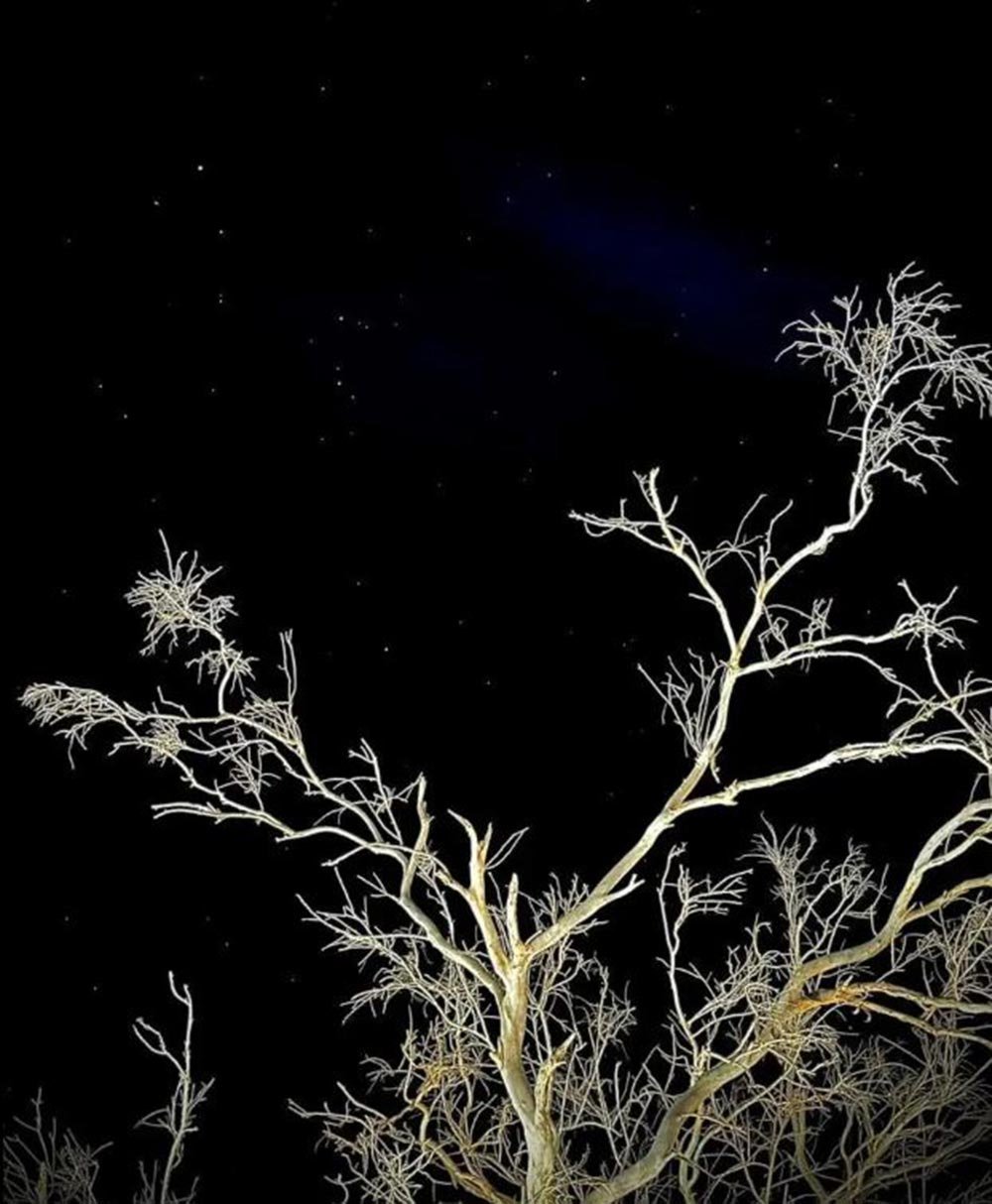
Rafha, November 10, 2026, SPA -- On a new moon night, as the Moon’s disk nearly disappears from view and its light fades, the night sky reveals a wealth of celestial wonders that are otherwise difficult to see. Stars, galaxies, nebulae and distant star clusters emerge more clearly, making this one of the best times for stargazing, particularly in places far from artificial light.
Member of the AFAQ Society for Astronomy Barjas Al-Fulaih, told the Saudi Press Agency (SPA) the new moon is among the best phases of the lunar cycle for observing faint celestial objects. With moonlight at its lowest, observers can see more stars and distant objects, especially in locations with clear skies and little artificial lighting.
He explained that the Moon does not actually disappear during this phase. Rather, the side facing Earth is not directly illuminated by the Sun, making the lunar disk invisible to the naked eye under normal conditions.
Only in exceptional astronomical and atmospheric conditions, and very close to the exact moment of the new moon, might an extremely thin crescent be spotted.
The new moon occurs at the end of one lunar cycle and the beginning of the next, when the Moon lies roughly between the Earth and the Sun. Because the side facing the Earth receives no direct sunlight, the Moon is generally not visible to the naked eye around this time. The phase itself spans a short period around the precise astronomical moment, with sightings of the Moon near that moment being exceedingly rare.
Al-Fulaih noted that the reduced moonlight during this phase improves night-sky visibility, creating better conditions for observing celestial objects whose faint light can easily be outshone by the Moon. These include galaxies, nebulae and star clusters.
He stressed the importance of choosing dark-sky locations away from cities and sources of light pollution to get the best results.
The new moon returns roughly every 29.5 days, a period known as the synodic month, which is the time between two successive new moons.
The darkness of the sky on these nights offers a particularly good opportunity to observe distant, faint objects, especially with telescopes and astronomical binoculars. Clear weather and distance from artificial light sources further enhance viewing conditions.
The new moon is one of the successive phases of the lunar cycle, during which the illuminated portion of the Moon’s surface appears to change as seen from Earth, as the positions of the Moon, Earth and Sun shift.